🍽
Fresh Catch
Grilled perfectly.
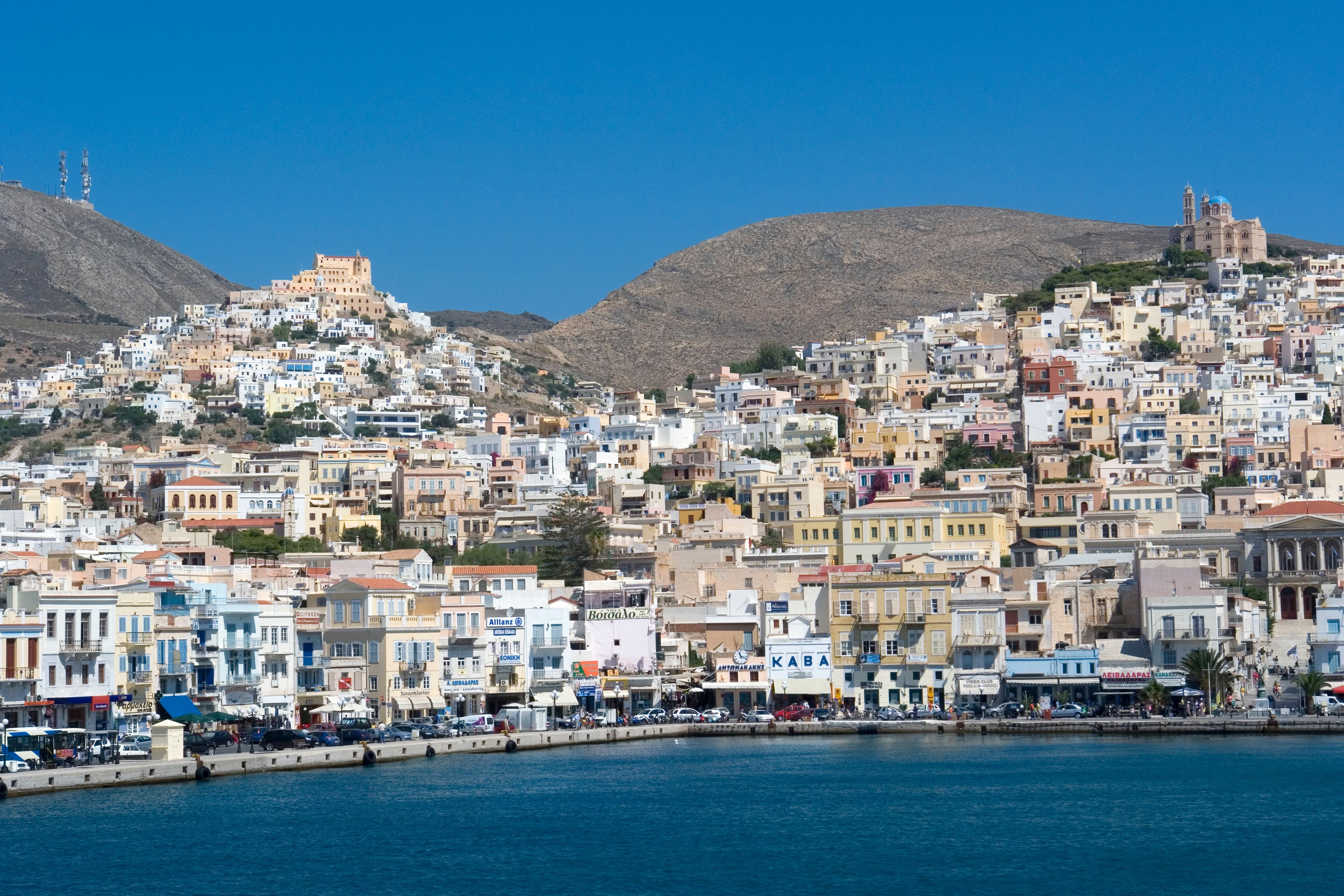
"Discover the authentic beauty of Syros."
The quarter of Vaporia is where sea captains traditionally lived. There are numerous neo-classical mansions along the quarter's narrow streets.
The history of settlement on Syros goes back at least 5,000 years, to the Early Bronze Age of the Cycladic civilization. This is when the hill-top settlement of Kastri began. Archaeologists describe Early Cycladic III (ECIII) culture as Kastri culture. It had links with the Anatolian Trade Network, connected with Limantepe in Asia Minor.
Throughout history, the island was known as Syra (Ancient Greek: Σύρα), then Syros or Siros (Σῦρος). In later times, it appears to have been inhabited by the Phoenicians. In the Odyssey, Syros was the country of the swineherd Eumaeus who described it at length (Odyssey, XV, 403 sq.), although it has also been suggested that Eumaeus referred to Syracuse, Sicily.
Research Note
Part of our exhaustive 2026 Golden Guide archive for Syros. Verified by local historians and environmental researchers.
The city hall is in the center of the town, in Miaoulis Square, ringed with cafés, seating areas, and palm trees. Dubbed the "City of Hermes", Syros has numerous churches, such as Metamorphosis, Koimisis, St. Demetrius, Three Hierarchs, Anastasis, Evangelistria, and St. Nicolas. There is an archaeological museum and a municipal library.
Ano Syros is the second town of Syros and was built by the Venetians at the beginning of the 13th century on the hill of San Giorgio, north-west of Ermoupoli. Ano Syros maintains a medieval atmosphere. Innumerable steps between narrow streets and houses with coloured doors lead to the top of the town. The medieval settlement of Ano Syros is accessible by car; the town is served mostly by marble steps. The distance from the harbour up to the main entry point of the town is about 1000 metres. The Catholic cathedral of Saint George dominates Ano Syros. The cathedral church was constructed during the 13th century. From the cathedral visitors have a panoramic view of the neighbouring islands of Tinos, Delos, Mykonos, Paros, Andros and Naxos.
The Roman Catholic diocese of Syros was a Latin diocese, suffragan of Naxos. The Venetians had established there a Latin bishopric which was subject to the Latin Archbishopric of Athens until 1525. From the time of the island's occupation by the Turks in the 16th century, the Greeks established an Orthodox metropolitan on Syros: Joseph is the earliest known, along with Symeon who died in 1594 and Ignatius in 1596. The island became for the most part Catholic.
Research Note
Part of our exhaustive 2026 Golden Guide archive for Syros. Verified by local historians and environmental researchers.
The city hall is in the center of the town, in Miaoulis Square, ringed with cafés, seating areas, and palm trees. Dubbed the "City of Hermes", Syros has numerous churches, such as Metamorphosis, Koimisis, St. Demetrius, Three Hierarchs, Anastasis, Evangelistria, and St. Nicolas. There is an archaeological museum and a municipal library.
Throughout history, the island was known as Syra (Ancient Greek: Σύρα), then Syros or Siros (Σῦρος). In later times, it appears to have been inhabited by the Phoenicians. In the Odyssey, Syros was the country of the swineherd Eumaeus who described it at length (Odyssey, XV, 403 sq.), although it has also been suggested that Eumaeus referred to Syracuse, Sicily.
At the end of ancient times, barbarian raids and piracy, which affected the Aegean for many centuries, led Syros to decline. The island, along with the other Cyclades, was devastated several times during the Middle Ages by raiders from different directions including Sicilians, Arabs, Turks and Venetians.
Research Note
Part of our exhaustive 2026 Golden Guide archive for Syros. Verified by local historians and environmental researchers.
Throughout history, the island was known as Syra (Ancient Greek: Σύρα), then Syros or Siros (Σῦρος). In later times, it appears to have been inhabited by the Phoenicians. In the Odyssey, Syros was the country of the swineherd Eumaeus who described it at length (Odyssey, XV, 403 sq.), although it has also been suggested that Eumaeus referred to Syracuse, Sicily.
Research Note
Part of our exhaustive 2026 Golden Guide archive for Syros. Verified by local historians and environmental researchers.
It had a Commercial Court of Law, a post office (one of the first in Greece), insurance brokerages, the first public school, a branch of the National Bank of Greece, art gallery, museum, library, a social club for the elite society etc. However, in 1854 cholera and a series of other epidemics plunged Syros into mourning. A number of charitable institutions for public health and social services were established during this period: orphanages, poorhouses and a mental hospital.
Festival of the Aegean (Official website of the music festival that has been held on the island since 2005.)
Research Note
Part of our exhaustive 2026 Golden Guide archive for Syros. Verified by local historians and environmental researchers.
The dishes that define this place
Grilled perfectly.
Artisan made.
Foraged daily.
Explore the ancient pathways.
A pristine spot away from the crowds.
Unmarked history.
Curated by locals, organised by depth
Watch the sun dip below the Aegean.
Find Hotels in Syros, Greece
via Booking.com — free cancellation on most rooms
Affiliate link — we earn a small commission at no extra cost to you