🍽
Fresh Catch
Grilled perfectly.
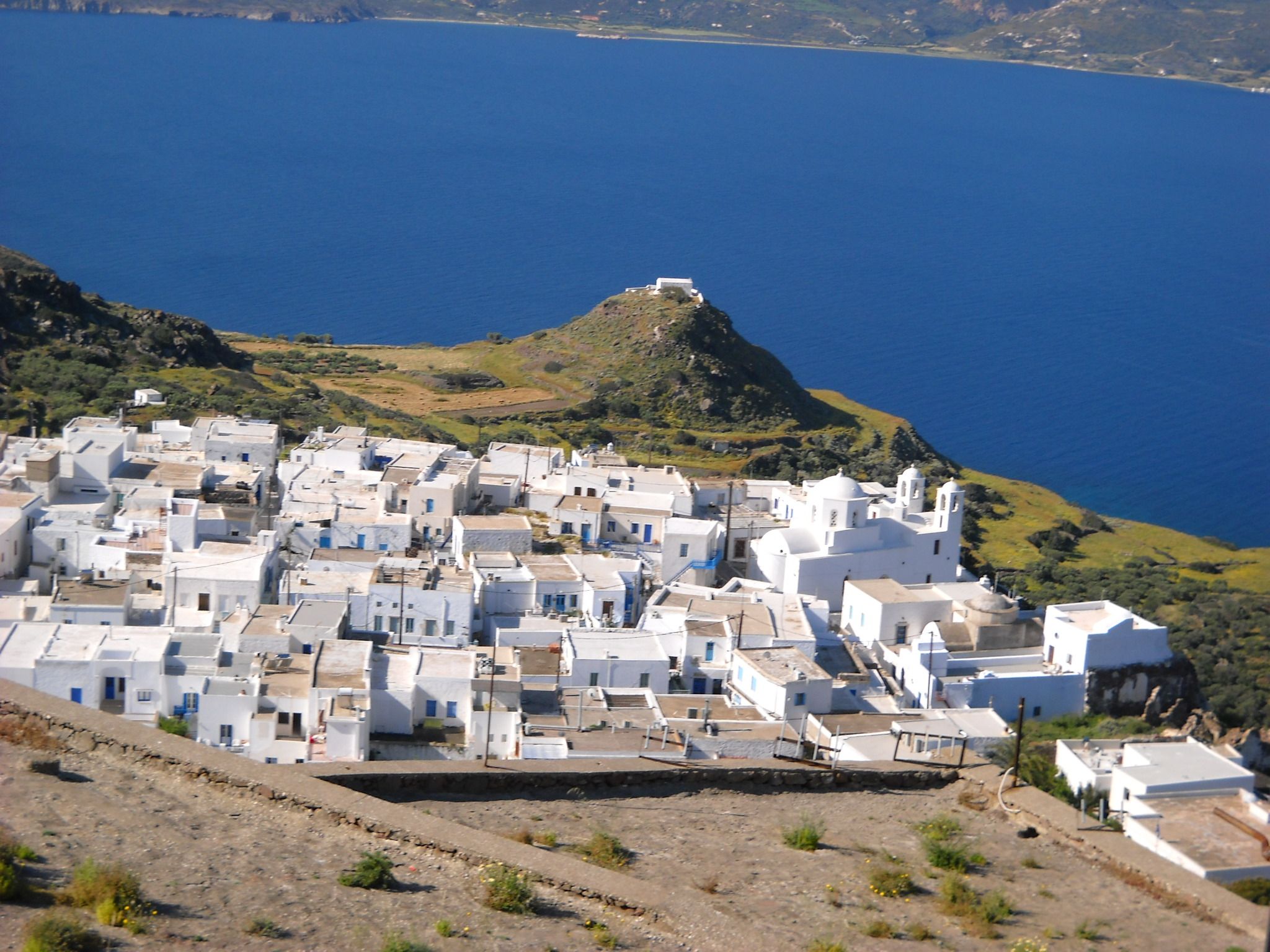
"Discover the authentic beauty of Milos."
The antiquities found at the site covered three major periods, from the Early Cycladic period to the Mycenaean period. At the site much pottery was excavated, with several changing styles and influences over the site's long occupation. In the early occupation of the site, there are many similarities and imports from other Cycladic islands and the settlement was very small. During the Middle Bronze Age however, the site expanded significantly and the expansion of Minoan Crete saw an influx of Minoan pottery into the Cyclades, particularly at Akrotiri on Thera, though much found its way to Phylakopi. The quantities found at the Cycladic sites have been taken to suggest a Minoan control over the region, though it could also be the consumptive nature of the islanders adopting Cretan fashions. There is more than just pottery at Phylakopi however, the eruption of the Thera volcano saw a reduction in Minoan presence in the Cyclades and it is at this time that Mycenaean involvement on the islands increases. At Phylakopi (and unknown in the rest of the Cyclades) a megaron structure, which is typically associated with the Mycenaean palaces, such as those at Tiryns, Pylos and Mycenae has been discovered. This has been taken to suggest that the Mycenaeans conquered the settlement and installed a seat of power for a governor. The evidence is not clear, though again it could be a legacy of the islanders adopting foreign elements into their culture. Particularly unexpected was the discovery in the 1970s of a shrine at the site, which contained many examples of Aegean figurines, including the famous "Lady of Phylakopi". The shrine is unprecedented in the Bronze Age Cyclades and has provided a valuable insight into the beliefs and rituals of the inhabitants of Phylakopi. The site was eventually abandoned and was never reoccupied.
During the second Persian invasion of Greece in 480 BC, the Melians refused to submit to Persia and contributed two warships to the Greek war effort, which were used at the Battle of Salamis. After the battle, the Melians returned to their traditional isolationism.
In 405 BC, with Athens losing the war, the Spartan general Lysander expelled the Athenian settlers from Melos and repatriated the survivors of the siege. Sparta annexed Melos, which would mean that like other liberated islands, it received a military governor (a harmost). The cultural distinctiveness of Melos faded away as it was absorbed into mainstream Greek culture. Their coinage switched to the Rhodian standard (tetradrachms weighing 15.3 g) and ceased bearing the word ΜΑΛΙΟΝ. The production of its terracotta reliefs also ceased.
Research Note
Part of our exhaustive 2026 Golden Guide archive for Milos. Verified by local historians and environmental researchers.
In the aftermath of the Fourth Crusade (1204), the Venetian Marco Sanudo seized control of Milos and a number of other islands in the Cyclades. Sanudo declared himself the Duke of Naxos, after the island where he established his capital. Sanudo did not make his duchy a vassal of Venice, but instead declared loyalty to the Latin Emperor. Sanudo's dynasty lasted nine generations, then was succeeded by the Crispos. Both families were Catholic. The majority of the population was (and still is) Greek Orthodox.
Up to this point, the population of Melos was overwhelmingly Greek Orthodox Christian, just like the rest of the archipelago. When the Venetians conquered the archipelago, they brought Catholicism with them. The first Catholic bishop of Milos was appointed in 1253.
In the early 18th century, the population surpassed 6,000 and was almost entirely Greek and Christian. It was ruled by a Turkish judge or kadi, and a Turkish governor or voivode. The voivode was responsible for collecting taxes and enforcing the decisions of the kadi. The day-to-day affairs of the island were managed by three elected magistrates (epitropi), although any of their decisions could be appealed to the kadi. The island had two bishops: one Greek Orthodox and one Latin Catholic. The Greek bishop was wealthier than his Latin counterpart, as he had a larger revenue base. Although the islanders enjoyed a great degree of autonomy, they chafed under the heavy taxation of their Ottoman overlords.
Research Note
Part of our exhaustive 2026 Golden Guide archive for Milos. Verified by local historians and environmental researchers.
Milos or Melos (; Modern Greek: Μήλος, romanized: Mílos, IPA: [ˈmilos]; Ancient Greek: Μῆλος, romanized: Mêlos) is a volcanic Greek island in the Aegean Sea, just north of the Sea of Crete. It is the southwestern-most of the Cyclades islands.
Sculptures from Milos include the Venus de Milo (now in the Louvre), the Poseidon of Melos (now in the NAMA), the Asclepius of Milos (now in the British Museum), and an archaic Apollo now in Athens. Milos is a popular tourist destination during the summer. The municipality of Milos also includes the uninhabited offshore islands of Antimilos and Akradies. The combined land area is 160.147 square kilometres (61.833 sq mi) and at the 2021 census the population was 5,193 inhabitants.
From the 6th century BC up to the siege of 416 BC, Melos issued its own coinage, struck according to the Milesian weight standard: the base coin was the stater which weighed just over 14 grams. Melos was the only island in the Aegean Sea to use this standard. Most coins bore the image of an apple, which is a pun because the ancient Greek word for "apple" (mêlon) sounded similar to the name of the island. The coins also often bore the name of its people: ΜΑΛΙΟΝ (Malion) or some abbreviation thereof.
Research Note
Part of our exhaustive 2026 Golden Guide archive for Milos. Verified by local historians and environmental researchers.
Explore the rich local heritage and uncover hidden secrets of this amazing destination.
Research Note
Part of our exhaustive 2026 Golden Guide archive for Milos. Verified by local historians and environmental researchers.
Explore the rich local heritage and uncover hidden secrets of this amazing destination.
Research Note
Part of our exhaustive 2026 Golden Guide archive for Milos. Verified by local historians and environmental researchers.
The dishes that define this place
Grilled perfectly.
Artisan made.
Foraged daily.
Explore the ancient pathways.
A pristine spot away from the crowds.
Unmarked history.
Curated by locals, organised by depth
Watch the sun dip below the Aegean.
Find Hotels in Milos, Greece
via Booking.com — free cancellation on most rooms
Affiliate link — we earn a small commission at no extra cost to you