🍽
Fresh Catch
Grilled perfectly.
"Discover the authentic beauty of Lesvos."
Two of the nine lyric poets in the Ancient Greek canon, Sappho and Alcaeus, were from Lesbos. Phanias wrote history. The seminal artistic creativity of those times brings to mind the myth of Orpheus to whom Apollo gave a lyre and the Muses taught to play and sing. When Orpheus incurred the wrath of the god Dionysus he was dismembered by the Maenads and of his body parts his head and his lyre found their way to Lesbos where they have "remained" ever since. Pittacus was one of the Seven Sages of Greece. In classical times, Hellanicus advanced historiography and Theophrastus, the father of botany, succeeded Aristotle as the head of the Lyceum. Aristotle and Epicurus lived there for some time, and it is there that Aristotle began systematic zoological investigations.
Theophanes, the historian who recorded Pompey's campaigns, was also from Lesbos. As the Greek novel Daphnis and Chloe is set on Lesbos, the author, Longus, is usually assumed to be from the island. The abundant grey pottery ware found on the island and the worship of Cybele, the great mother-goddess of Anatolia, suggest the cultural continuity of the population from Neolithic times. When the Persian king Cyrus the Great defeated Croesus (546 BC) the Ionic Greek cities of Anatolia and the adjacent islands became Persian subjects and remained such until the Persians were defeated by the Greeks at the Battle of Salamis (480 BC). The island was governed by an oligarchy in archaic times, followed by quasi-democracy in classical times. Around this time, Arion developed the type of poem called dithyramb, the progenitor of tragedy, and Terpander invented the seven-note musical scale for the lyre. For a short period it was a member of the Athenian confederacy, its apostasy from which is recounted by Thucydides in the Mytilenian Debate, in Book III of his History of the Peloponnesian War. In Hellenistic times, the island belonged to various Diadochi of Alexander the Great until 79 BC when it passed into Roman hands. Remnants of its Roman medieval history are three impressive castles. The cities of Mytilene and Methymna have been bishoprics since the 5th century. By the early 10th century, Mytilene had been raised to the status of a metropolitan see. Methymna achieved the same by the 12th century.
In April 2022, the Greek government announced a dedication of €2 million in restoring tourism in Lesbos and four other islands. In October 2022, it was announced that Lesbos would return to the cruise ship industry. Konstantinos Moutzouris, the governor of the North Aegean Region, which Lesbos is under, explained that the region's administration will run a study "in order to develop cruise tourism on the island." The deputy governor of tourism, Nikolaos Nyktas, believed that the cruise industry "suits the island and its culture", while the head of development for the project, Ioannis Bras, said that the island could "offer a lot to the cruise market".
Research Note
Part of our exhaustive 2026 Golden Guide archive for Lesvos. Verified by local historians and environmental researchers.
After the Fall of Constantinople in 1453, the Gattilusi continued to rule Lesbos as tributary vassals to the Ottoman Empire, until the island was conquered by Sultan Mehmed II in September 1462. After the capture of Lesbos, the richer inhabitants were moved to Constantinople in order to repopulate the city, some boys and girls were taken away into imperial service, but the rest of the population remained. Mehmed II brought in Muslim settlers from Rumelia and Anatolia, and encouraged his Janissaries to settle there and take local wives. Among them was Yakub, the father of the pirate admiral Hayreddin Barbarossa. Named Midilli (مدللى) after its capital, Mytilene, the island became a sanjak (province) of the Eyalet of Rumelia, and after 1534 of the Eyalet of the Archipelago. Mytilene and Molova (the Turkish name for Molyvos/Methymna) became seats of kadis. The cathedral of Mytilene was converted into a mosque. Otherwise, the organization of the local Orthodox church was not altered.
The relative prosperity of the island—wealth was apparently concentrated among the Greek Christian bourgeoisie rather than the Muslim community—contributed to the island not taking part in the Greek War of Independence in 1821–1829. During the second half of the 19th century, this prosperity became evident in the construction of large and ornamented mansions and churches; the Muslims followed suit, employing the fashionable Neo-Classical and Neo-Gothic styles in their own renovations of their mosques, especially after the destructive 1867 earthquake. The Ottoman writer and liberal politician Namık Kemal served in the local administration in 1877–1884. In 1905, four European powers seized the customs and telegraph offices in the island to pressure the Ottoman government to accept their plan for an international commission that would supervise the provinces of Macedonia.
Catholic Church of Theotokos, where part of the relics of Saint Valentine are kept
Research Note
Part of our exhaustive 2026 Golden Guide archive for Lesvos. Verified by local historians and environmental researchers.
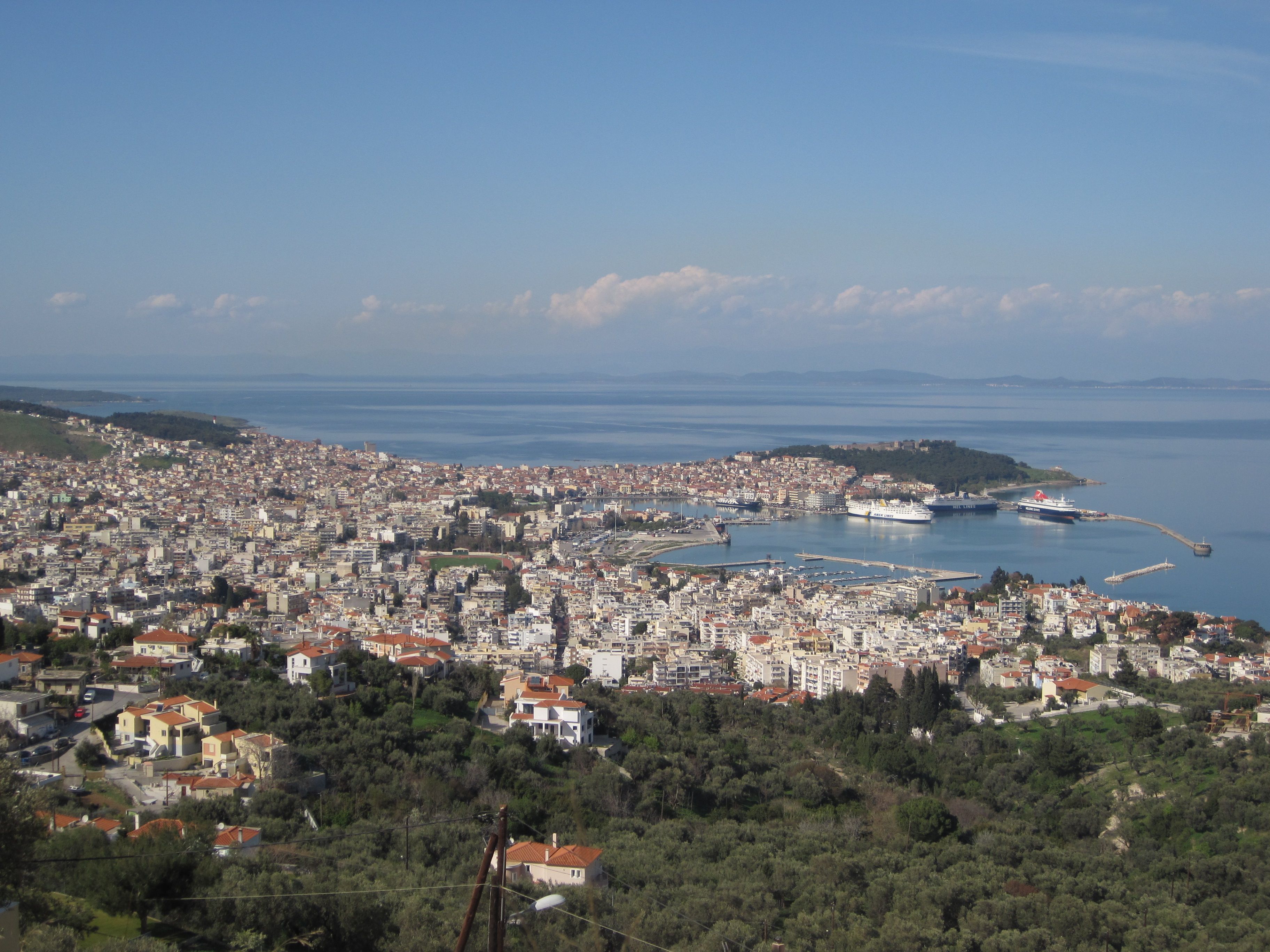
Lesbos or Lesvos (Greek: Λέσβος, romanized: Lésvos [ˈlezvos]) is a Greek island located in the northeastern Aegean Sea. It has an area of 1,633 km2 (631 sq mi), with approximately 400 km (249 mi) of coastline, making it the third largest island in Greece and the eighth largest in the Mediterranean. It is separated from Asia Minor by the narrow Mytilini Strait. On the southeastern coast is the island's capital and largest city, Mytilene (Μυτιλήνη), whose name is also used for the island as a whole. Lesbos is a separate regional unit with the seat in Mytilene, which is also the capital of the larger North Aegean region. The region includes the islands of Lesbos, Chios, Ikaria, Lemnos, and Samos. The total population of the island was 83,755 in 2021. A third of the island's inhabitants live in the capital, while the remainder are concentrated in small towns and villages. The largest are Plomari, Agia Paraskevi, Polichnitos, Agiassos, Eresos, Gera, and Molyvos (the ancient Mythimna).
According to later Greek writers, Mytilene was founded in the 11th century BC by the family Penthilidae, who arrived from Thessaly and ruled the city-state until a popular revolt (590–580 BC) led by Pittacus of Mytilene ended their rule. In fact, the archaeological and linguistic records may indicate a late Iron Age arrival of Greek settlers, although references in Late Bronze Age Hittite archives indicate a likely Greek presence then. According to Homer's Iliad, Lesbos was part of the kingdom of Priam, which ruled from Troy. In the Middle Ages, it was under Byzantine and then Genoese rule. Lesbos was conquered by the Ottoman Empire in 1462. The Ottomans then ruled the island until the First Balkan War in 1912, when it became part of the Kingdom of Greece.
The English name Lesbos (pronounced , also US: ) is from Ancient Greek Λέσβος (Lésbos). The name appears in Late Bronze Age Hittite texts as Lazpa (Hittite: 𒆷𒊍𒉺 Lāzpa). The earliest reference to Lesbos in Greek texts comes from the Homeric poems, where it is described as "well-built". The etymology of the name is obscure, but may have originally meant 'forested', 'wooded'.
Research Note
Part of our exhaustive 2026 Golden Guide archive for Lesvos. Verified by local historians and environmental researchers.
Lesbos prospered from trade, and Mytilene was considered the busiest Ottoman port in the Aegean Sea. West European representatives are attested in the city already in 1700, acting as vice-consuls for the consulates in Smyrna. The island exported olives and olive oil, wheat, grapes, raisins and wine, figs, fish, dairy products, acorns, soap, leather and hides, pitch and livestock. Mytilene itself increased five-fold in population during the Ottoman period. A number of new mosques were erected in the city, and Hayreddin Barbarossa built a madrasa, dervish lodge, and imaret erected in his hometown. Many of the early Ottoman buildings, as well as the city walls, were destroyed in the earthquake of 1867. Mevlevi and Bektashi lodges are attested, since 1544 for the former, and since 1699 for the latter. Molyvos, which was the island's second city for most of the Ottoman period, also experienced growth, doubling in size; unlike Mytilene, the Muslim element came to predominate, and comprised over half the population by 1874. Mosques were built and fortifications were undertaken during the long Cretan War with Venice. But during the 19th century, the town declined rapidly in importance and number of inhabitants, a decline which continued to modern times. In the mid-18th century, the castle and settlement of Sigri were established to protect the western coast from pirate attacks.
Research Note
Part of our exhaustive 2026 Golden Guide archive for Lesvos. Verified by local historians and environmental researchers.
The main football clubs in the island are Aiolikos,
Research Note
Part of our exhaustive 2026 Golden Guide archive for Lesvos. Verified by local historians and environmental researchers.
The dishes that define this place
Grilled perfectly.
Artisan made.
Foraged daily.
Explore the ancient pathways.
A pristine spot away from the crowds.
Unmarked history.
Curated by locals, organised by depth
Watch the sun dip below the Aegean.
Find Hotels in Lesvos, Greece
via Booking.com — free cancellation on most rooms
Affiliate link — we earn a small commission at no extra cost to you