CYouInGreece
The Real Aegean
Delphi
archaeological site — Greece

Delphi

"Discover the authentic beauty of Delphi."

Culture

Culture in Delphi

Ancient tradition refers to a succession of mythical temples on the site: first one built of olive branches from Tempe, then one built of beeswax and wings by bees, and thirdly one built by Hephaestus and Athena. The first archaeologically attested structure was built in the seventh century BC and is attributed in legend to the architects Trophonios and Agamedes. It burnt down in 548/7 BC and the Alcmaeonids built a new structure which itself burnt down in the fourth century BC.

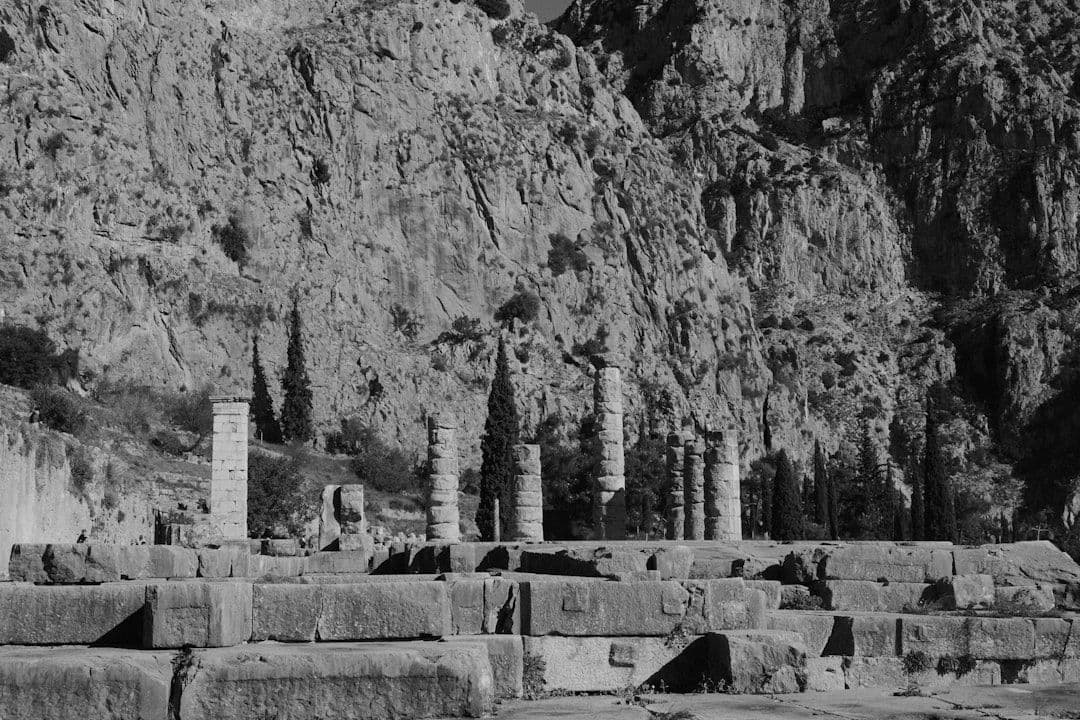
Although the architecture at Delphi is generally Doric, a plain style, in keeping with the Phocian traditions that were Doric, the Athenians did not prefer the Doric. The stoa was built in their own preferred style, the Ionic order, the capitals of the columns being a sure indicator. In the Ionic order they are floral and ornate, although not so much as the Corinthian, which is in deficit there. The remaining porch structure contains seven fluted columns, unusually carved from single pieces of stone (most columns were constructed from a series of discs joined). The inscription on the stylobate indicates that it was built by the Athenians after their naval victory over the Persians in 478 BC, to house their war trophies. At that time the Athenians and the Spartans were on the same side.

In the Iliad, Achilles would not accept Agamemnon's peace offering even if it included all the wealth in the "stone floor" of "rocky Pytho" (I 404). In the Odyssey (θ 79) Agamemnon crosses a "stone floor" to receive a prophecy from Apollo in Pytho, the first known of proto-history. Hesiod also refers to Pytho "in the hollows of Parnassus" (Theogony 498). These references imply that the earliest date of the oracle's existence is the eighth century BC, the probable date of composition of the Homeric works.

Churches

Churches in Delphi

Despite the rise of Christianity across the Roman Empire, the oracle remained a religious center throughout the fourth century, and the Pythian Games continued to be held at least until 424 AD; however, the decline continued. The attempt of Emperor Julian to revive polytheism did not survive his reign. Excavations have revealed a large three-aisled basilica in the city, as well as traces of a church building in the sanctuary's gymnasium. The site was abandoned in the sixth or seventh centuries, although a single bishop of Delphi is attested in an episcopal list of the late eighth and early ninth centuries.

The Ottomans finalized their domination over Phocis and Delphi in about 1410 AD. Delphi itself remained almost uninhabited for centuries. It seems that one of the first buildings of the early modern era was the monastery of the Dormition of Mary or of Panagia (the Mother of God) built above the ancient gymnasium at Delphi. It must have been toward the end of the fifteenth or in the sixteenth century that a settlement started forming there, which eventually ended up forming the village of Kastri.

Museums

Museums in Delphi

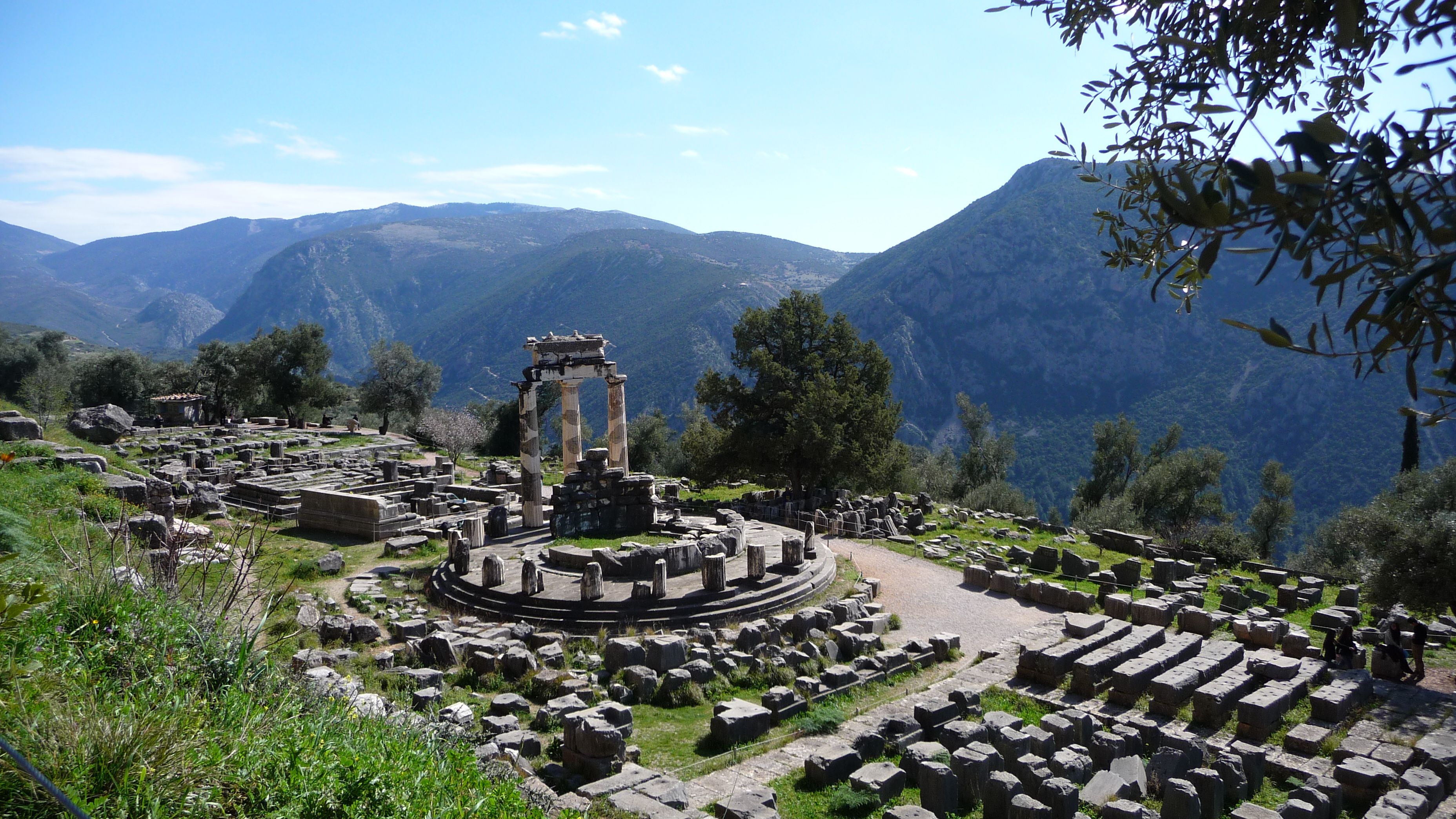
Delphi (; Greek: Δελφοί [ðelˈfi]), in legend previously called Pytho (Πυθώ), was an ancient sacred precinct in central Greece. It was the seat of Pythia, the major oracle who was consulted about important decisions throughout the ancient classical world. The ancient Greeks considered the centre of the world to be in Delphi, marked by the stone monument known as the Omphalos of Delphi. The term omphalos was the Greek word for "navel".

It is now an extensive archaeological site, and since 1938 a part of Parnassos National Park. The precinct is recognized by UNESCO as a World Heritage Site in having had a great influence in the ancient world, as evidenced by the various monuments built there by most of the important ancient Greek city-states, demonstrating their fundamental Hellenic unity.

Today Delphi is a municipality of Greece as well as a modern town adjacent to the ancient precinct. The modern town was created after removing buildings from the sacred precinct so that the latter could be excavated. The two Delphis, old and new, are located on Greek National Road 48 between Amfissa in the west and Livadeia, capital of Boeotia, in the east. The road follows the northern slope of a pass between Mount Parnassus on the north and the mountains of the Desfina Peninsula on the south. The pass is of the river Pleistos, running from east to west, forming a natural boundary across the north of the Desfina Peninsula, and providing an easy route across it.

Gastronomy

Gastronomy in Delphi

Explore the rich local heritage and uncover hidden secrets of this amazing destination.

Entertainment

Entertainment in Delphi

On the occasion of Nero's visit to Greece in 67 A.D. various alterations took place. The orchestra was paved and delimited by a parapet made of stone. The proscenium was replaced by a low pedestal, the pulpitum; its façade was decorated in relief with scenes from myths about Hercules. Further repairs and transformations took place in the second century A.D. Pausanias mentions that these were carried out under the auspices of Herod Atticus. In antiquity, the theatre was used for the vocal and musical contests that formed part of the programme of the Pythian Games in the late Hellenistic and Roman period. The theatre was abandoned when the sanctuary declined in Late Antiquity. After its excavation and initial restoration it hosted theatrical performances during the Delphic Festivals organized by A. Sikelianos and his wife, Eva Palmer, in 1927 and in 1930. It has recently been restored again as the serious landslides posed a grave threat for its stability for decades.

An open market was probably established, where the visitors would buy ex-votos, such as statuettes and small tripods, to leave as offerings to the gods. It also served as an assembly area for processions during sacred festivals.

According to the Homeric hymn to the Pythian Apollo, Apollo shot his first arrow as an infant that effectively slew the serpent Pytho, the son of Gaia, who guarded the spot. To atone the murder of Gaia's son, Apollo was forced to fly and spend eight years in menial service before he could return forgiven. A festival, the Septeria, was held every year, at which the whole story was represented: the slaying of the serpent, and the flight, atonement, and return of the god.

Local Perspective

The Diary of Nikos

"The secrets you won't find in the official archives."

Nikos' Diary
Delphi Archaeological Site

Sun-Scorched Stone and the Drone of Humanity

The sun here isn't polite; it's a hammer. We started the climb up to the sanctuary before the main wave of tour buses disgorged their chattering masses, but the air was already thick with the scent of dry earth and impending heat. Each worn step to the Temple of Apollo, then higher to the theater, feels like a penitence. You try to imagine the silence, the gravitas, the Oracle's whispers, but it's hard when some influencer is posing for the hundredth time on a crumbling wall. The sheer scale, though, the way these stones cling to the mountain, still gives you pause.

Further up, at the Stadium, the wind whips at you, a fleeting reminder of the athletes who once pushed their limits here. Below, the 'sacred way' is a conveyor belt of fanny packs and selfie sticks. It’s a testament to the site's raw power that it can still resonate through all that manufactured noise. You can almost feel the old gods, or at least the desperation of those who sought their counsel, if you just manage to tune out the drone of modern tourism for a moment.

The Verdict

"A testament to ancient ambition, slightly dulled by contemporary distractions. Go early, very early."

Nikos' Diary
Arachova Town

Arachova: Alpine Bluster and Pseudo-Chic

Arachova, perched on Mount Parnassus, fancies itself a ski resort, a mountain retreat. And it is, to a degree. The air is sharp, the stone houses are sturdy, and there's a certain raw beauty to the place. But it’s also undeniably fallen prey to the weekend crowd from Athens, with boutique shops selling overpriced trinkets and 'traditional' tavernas that feel a little too polished. The main street buzzes with expensive cars and people dressed in winter gear that's never seen a proper slope.

Still, if you duck into one of the older kafenions off the main drag, where the elderly men play backgammon and the coffee is thick enough to stand a spoon in, you get a glimpse of the real town. The smell of woodsmoke and roasting meat still hangs heavy in the side alleys. It's a place of contrasts: genuine mountain grit fighting a losing battle against the encroaching demands of 'luxury' tourism. Don't expect rustic charm; expect a brisk wind and a lot of fur coats.

The Verdict

"A useful base, but it's traded some of its soul for designer skiwear. Get in, get out, head for the hills."

Nikos' Diary
Road from Delphi to Kirra

Olives, Dust, and the Descent to the Sea

Leaving the altitude and the ancient ghosts of Delphi, the road snakes down towards the Gulf of Corinth. This isn't the postcard view; this is miles of gnarled olive trees, stretching across the valley like an infinite, silver-green carpet. The air changes, growing warmer, heavier, thick with the scent of dust and dry earth. It’s a hypnotic drive, the world opening up before you, the stark mountains giving way to the shimmering blue of the sea in the distance.

This descent, through the groves that have fed generations, feels more authentic than any polished marble ruin. You pass tiny, forgotten churches, roadside shrines, and the occasional farmer coaxing a tractor through the ancient trees. The port town of Kirra, when it finally appears, is unassuming, salty, and real. A couple of weathered fishing boats, a taverna or two. No pretensions, just the smell of the sea and the quiet hum of local life. This is the unvarnished Greece.

The Verdict

"The journey, often overlooked, is a visceral experience of Greek landscape and livelihood. Seek it out."

Gastronomy

What to Eat.
And Where to Find It.

Taste of the Land

The dishes that define this place

🍽

This isn't for the squeamish. Lamb offal (heart, liver, lungs) seasoned, wrapped in intestines, and roasted slowly on a rotating spit over an open fire. It's unapologetically greasy, deeply savory, and aggressively flavorful. Find it at a roadside grill or a working-class taverna, sliced thick and served with a squeeze of lemon and maybe a shot of fiery tsipouro. An absolute assault on the senses, in the best possible way.
🍽

Forget the bland feta in your supermarket. This is a substantial block of tangy, salty Greek feta, baked in a small clay dish with ripe tomatoes, bell peppers, a dash of fiery chili flakes, and a generous slick of olive oil. The cheese softens, the flavors meld, and it becomes a hearty, satisfying starter. Perfect with some crusty bread to sop up the oily, spicy juices. Simple, rustic, perfect.

🍽

Not all 'traditional' desserts are created equal. Seek out a proper bakery in Arachova that makes its galaktoboureko from scratch. It's a semolina custard, creamy and rich, encased in layers of crisp, buttered phyllo pastry, baked golden, and drizzled with a light, fragrant lemon-infused syrup. It should be warm, not cloyingly sweet, and have that satisfying crunch from the phyllo contrasting with the silken custard. Pair it with a strong Greek coffee.

Off the Map

What the Guidebooks Miss.

💎 Only locals know
Korykeion Cave (Cave of Pan)

Korykeion Cave (Cave of Pan)

Forget the well-trodden paths. This is a rough, untamed cave on Mount Parnassus, a strenuous scramble above the main Delphi site. Dark, damp, and truly wild. It's where ancient Dionysian rites are said to have taken place, far from any official altar. Go with a flashlight and a healthy respect for the wild, and you'll feel the primal energy that guided the ancients.

💎 Only locals know
The Old Pilgrimage Path to Kirra

The Old Pilgrimage Path to Kirra

Ditch the car. This is the original, punishing route pilgrims took from the port of Kirra up to the Oracle. Starting near the ancient gymnasium below Delphi, it’s a rocky, steep descent through dense olive groves. Miles of silence, broken only by cicadas and your own heavy breathing. It's hot, it's dusty, but it connects you directly to the grit and effort of the past. It’s a genuine pilgrimage, not a leisurely hike.

💎 Only locals know

Taverna Apolafsi, Chrisso Village

Forget the tourist traps in Delphi town. Chrisso, a village just a few kilometers away, has its own pace. Apolafsi is a simple, no-frills taverna in the main square. Expect lamb chops grilled over charcoal until they're charred and juicy, served with robust village salad and cheap, honest house wine. This is where the locals gather, where the conversation is loud and real, and the food speaks for itself without unnecessary fuss.

Experiences

How to Spend Your Days.

Top Experiences

Curated by locals, organised by depth

Sneak in just as the sun cracks over the mountains, before the hordes descend. The air is cool, carrying the scent of wild herbs. Ascend through the silent, dew-kissed ruins to the ancient stadium. Stand on the worn starting line, gaze across the empty stone seating, and feel the sheer, unadulterated weight of history. The olive valley below unfurls in the soft light. This is when Delphi speaks, without the competing clamor of modern tourism.

Plan Your Trip

Book your Delphi experience.

B.

Find Hotels in Delphi, Greece

via Booking.com — free cancellation on most rooms

Search Available Hotels →

Affiliate link — we earn a small commission at no extra cost to you

← Return to Encyclopaedia