🍽
Fresh Catch
Grilled perfectly.
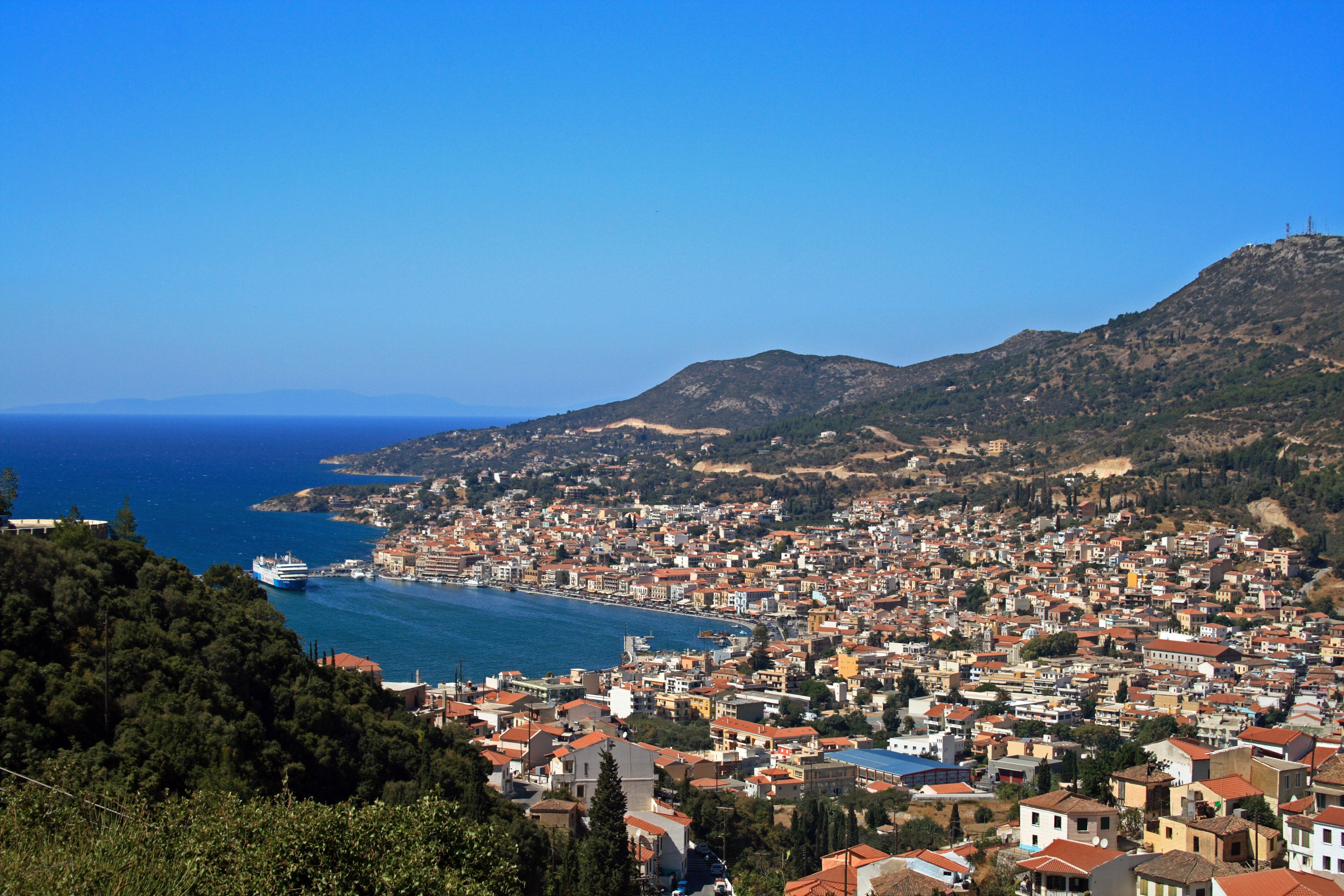
"Discover the authentic beauty of Samos."
In classical antiquity, the island was a centre of Ionian culture and luxury, renowned for its Samian wines and its red pottery (called Samian ware by the Romans). Its most famous building was the Ionic order archaic Temple of goddess Hera—the Heraion.
Concerning the earliest history of Samos, literary tradition is singularly defective. At the time of the great migrations, it received an Ionian population which traced its origin to Epidaurus in Argolis: Samos became one of the twelve members of the Ionian League. By the 7th century BC, it had become one of the leading commercial centres of Greece. This early prosperity of the Samians seems largely due to the island's position near trade routes, which facilitated the import of textiles from inner Asia Minor, but the Samians also developed an extensive oversea commerce. They helped to open up trade with the population that lived around the Black Sea as well as with Egypt, Cyrene (Libya), Corinth, and Chalcis. Among the colonies the Samians founded, most of them in the sixth century BC, were Bisanthe, Perinthus, and Samothrace (northern Aegean Sea), Cydonia (Crete), Nagidos and Kelenderis (southern Anatolia), Dicaearchia (Italy), and Oasis Polis (Egypt). The trade caused them to become bitter rivals with Miletus. Samos was able to become so prominent despite the growing power of the Persian empire because of the alliance they had with the Egyptians and their powerful fleet. The Samians are also credited with having been the first Greeks to reach the Straits of Gibraltar.
In the 6th century BC, Samos was ruled by the famous tyrant Polycrates. During his reign, two working groups under the leadership of the engineer Eupalinos dug a tunnel through Mount Kastro to build an aqueduct to supply the ancient capital of Samos with fresh water, as this was of the utmost defensive importance (since being underground, it was not easily detected by an enemy who could otherwise cut off the supply). Eupalinos's tunnel is particularly notable because it is the second earliest tunnel in history to be dug from both ends in a methodical manner. With a length of over 1 km (0.6 mi), Eupalinos's subterranean aqueduct is today regarded as one of the masterpieces of ancient engineering. The aqueduct is now part of the UNESCO World Heritage Site, the Pythagoreion.
Research Note
Part of our exhaustive 2026 Golden Guide archive for Samos. Verified by local historians and environmental researchers.
Under Ottoman rule, Samos (Ottoman Turkish: سيسام Sisam) came under the administration of the Kapudan Pasha's Eyalet of the Archipelago, usually as part of the Sanjak of Rhodes rather than as a distinct province. Locally, the Ottoman authorities were represented by a voevoda, who was in charge of the fiscal administration, the kadi (judge), the island's Orthodox bishop and four notables representing the four districts of the island (Vathy, Chora, Karlovasi and Marathokampos). Ottoman rule was interrupted during the Russo-Turkish War of 1768–1774, when the island came under Russian control in 1771–1774.
The Treaty of Küçük Kaynarca that concluded the war contained clauses that enabled a great expansion of the commercial activities of the Ottoman Empire's Greek Orthodox population. Samian merchants also took advantage of this, and an urban mercantile class based on commerce and shipping began to grow. The Samian merchants' voyages across the Mediterranean, as well as the settlement of Greeks from the Ionian Islands (which in 1797 had passed from Venice to the French Republic), introduced to Samos the progressive ideas of the Age of Enlightenment and of the French Revolution, and led to the formation of two rival political parties, the progressive-radical Karmanioloi ("Carmagnoles", named after the French Revolutionary song Carmagnole) and the reactionary Kallikantzaroi ("goblins") who represented mostly the traditional land-holding elites. Under the leadership of Lykourgos Logothetis, in 1807 the Karmanioloi gained power in the island, introducing liberal and democratic principles and empowering the local popular assembly at the expense of the land-holding notables. Their rule lasted until 1812, when they were overthrown by the Ottoman authorities and their leaders expelled from the island.
In 1834, the island of Samos became the territory of the Principality of Samos, a semi-independent state tributary to Ottoman Turkey, paying the annual sum of £2,700. It was governed by a Christian of Greek descent though nominated by the Porte, who bore the title of "Prince." The prince was assisted in his function as chief executive by a 4-member senate. These were chosen by him out of eight candidates nominated by the four districts of the island: Vathy, Chora, Marathokampos, and Karlovasi. The legislative power belonged to a chamber of 36 deputies, presided over by the Greek Orthodox Metropolitan. The seat of the government was the port of Vathý.
Research Note
Part of our exhaustive 2026 Golden Guide archive for Samos. Verified by local historians and environmental researchers.
In ancient times, Samos was an especially rich and powerful city-state, particularly known for its vineyards and wine production. It is home to Pythagoreion and the Heraion of Samos, a UNESCO World Heritage Site that includes the Eupalinian aqueduct, a marvel of ancient engineering. Samos is the birthplace of the Greek philosopher and mathematician Pythagoras, after whom the Pythagorean theorem is named, the philosophers Melissus of Samos and Epicurus, and the astronomer Aristarchus of Samos, the first known individual to propose that the Earth revolves around the Sun. Samian wine was well known in antiquity and is still produced on the island.
In the 6th century BC, Samos was ruled by the famous tyrant Polycrates. During his reign, two working groups under the leadership of the engineer Eupalinos dug a tunnel through Mount Kastro to build an aqueduct to supply the ancient capital of Samos with fresh water, as this was of the utmost defensive importance (since being underground, it was not easily detected by an enemy who could otherwise cut off the supply). Eupalinos's tunnel is particularly notable because it is the second earliest tunnel in history to be dug from both ends in a methodical manner. With a length of over 1 km (0.6 mi), Eupalinos's subterranean aqueduct is today regarded as one of the masterpieces of ancient engineering. The aqueduct is now part of the UNESCO World Heritage Site, the Pythagoreion.
The modern capital of the island was, until the early 20th century, at Chora, about 2 miles (3.2 km) from the sea and from the site of the ancient city.
Research Note
Part of our exhaustive 2026 Golden Guide archive for Samos. Verified by local historians and environmental researchers.
In ancient times, Samos was an especially rich and powerful city-state, particularly known for its vineyards and wine production. It is home to Pythagoreion and the Heraion of Samos, a UNESCO World Heritage Site that includes the Eupalinian aqueduct, a marvel of ancient engineering. Samos is the birthplace of the Greek philosopher and mathematician Pythagoras, after whom the Pythagorean theorem is named, the philosophers Melissus of Samos and Epicurus, and the astronomer Aristarchus of Samos, the first known individual to propose that the Earth revolves around the Sun. Samian wine was well known in antiquity and is still produced on the island.
A great portion of the island is covered with vineyards, from which Muscat wine is made. The most important plains other than the capital, Vathy, in the northeast, are those of Karlovasi, in the northwest, Pythagoreio, in the southeast, and Marathokampos in the southwest. The island's population is 33,814, which makes it the 9th most populous of the Greek islands. The Samian climate is typically Mediterranean, with mild rainy winters, and warm rainless summers.
In classical antiquity, the island was a centre of Ionian culture and luxury, renowned for its Samian wines and its red pottery (called Samian ware by the Romans). Its most famous building was the Ionic order archaic Temple of goddess Hera—the Heraion.
Research Note
Part of our exhaustive 2026 Golden Guide archive for Samos. Verified by local historians and environmental researchers.
Explore the rich local heritage and uncover hidden secrets of this amazing destination.
Research Note
Part of our exhaustive 2026 Golden Guide archive for Samos. Verified by local historians and environmental researchers.
The dishes that define this place
Grilled perfectly.
Artisan made.
Foraged daily.
Explore the ancient pathways.
A pristine spot away from the crowds.
Unmarked history.
Curated by locals, organised by depth
Watch the sun dip below the Aegean.
Find Hotels in Samos, Greece
via Booking.com — free cancellation on most rooms
Affiliate link — we earn a small commission at no extra cost to you