🍽
Fresh Catch
Grilled perfectly.
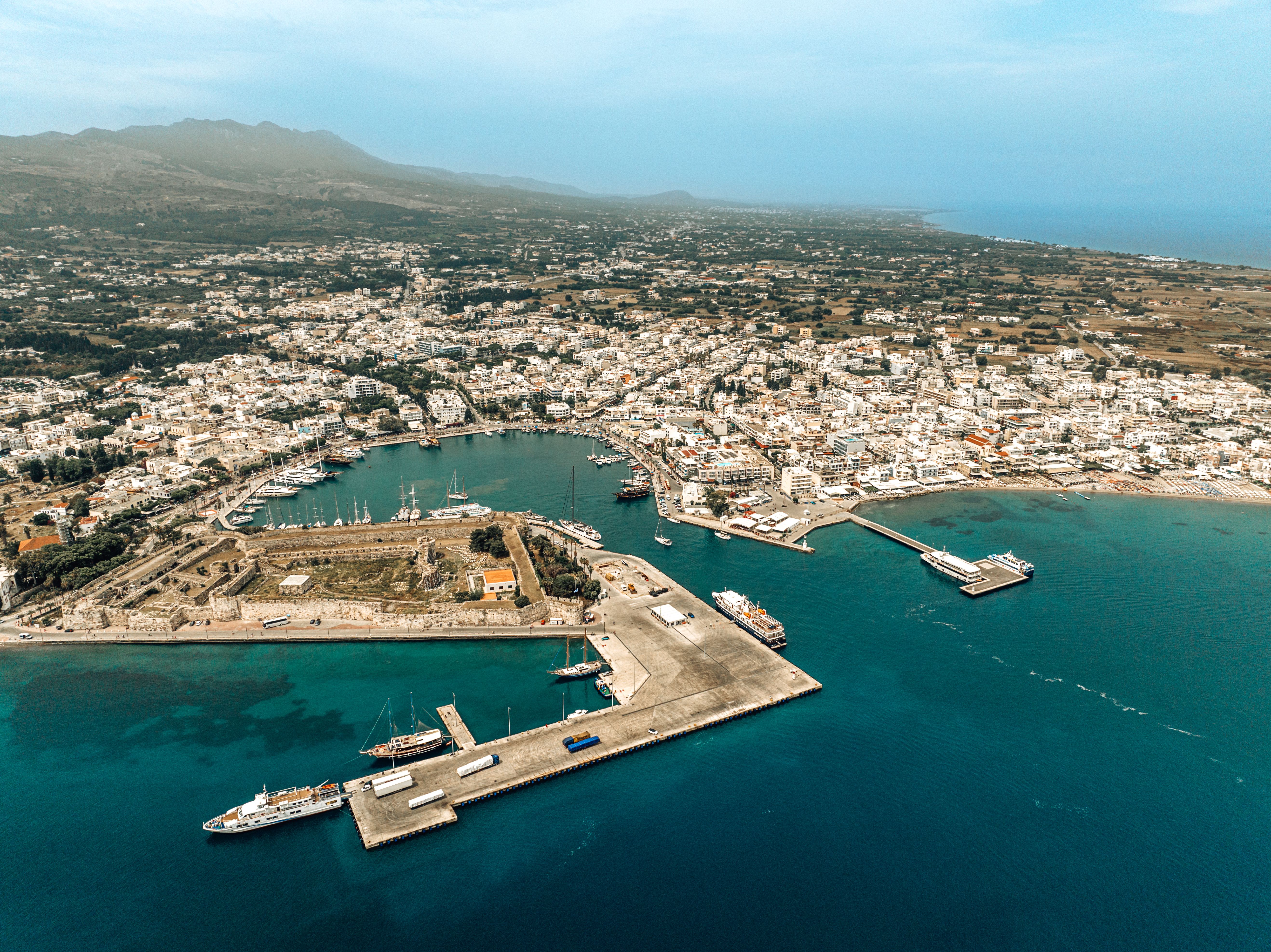
"Discover the authentic beauty of Kos."
Its early history – as part of the religious-political amphictyonic league that included Lindos, Kamiros, Ialysos, Knidos and Halicarnassus, the Doric Hexapolis (hexapolis means 'six cities' in Greek), – is obscure. At the end of the 6th century, Kos fell under Achaemenid domination but rebelled after the Greek victory at the Battle of Mycale in 479. Archaeological finds have shown the existence of a small shrine to Hemera and Helios; gods of the day and the sun respectively.
The bishopric of Kos was a suffragan of the metropolitan see of Rhodes. Its bishop Meliphron attended the First Council of Nicaea in 325. Eddesius was one of the minority Eastern bishops who withdrew from the Council of Sardica in about 344 and set up a rival council at Philippopolis. Iulianus went to the synod held in Constantinople in 448 in preparation for the Council of Chalcedon of 451, in which he participated as a legate of Pope Leo I, and he was a signatory of the joint letter that the bishops of the Roman province of Insulae sent in 458 to Byzantine Emperor Leo I the Thracian with regard to the killing of Proterius of Alexandria. Dorotheus took part in a synod in 518. Georgius was a participant of the Third Council of Constantinople in 680–681. Constantinus went to the Photian Council of Constantinople (879). Under Byzantine rule, apart from the participation of its bishops in councils, the island's history remains obscure. It was governed by a droungarios in the 8th–9th centuries, and seems to have acquired some importance in the 11th and 12th centuries: Nikephoros Melissenos began his uprising here, and in the middle of the 12th century, it was governed by a scion of the ruling Komnenos dynasty, Nikephoros Komnenos.
The ancient physician Hippocrates is thought to have been born in Kos, and in the center of the town is the Plane Tree of Hippocrates; a dream temple where the physician is traditionally supposed to have taught. The limbs of the now elderly tree are supported by scaffolding. The small city is also home to the International Hippocratic Foundation of Kos, and the Hippocratic Museum dedicated to him. Near the institute are the ruins of Asklepieion, where Herodicus taught Hippocrates medicine.
Research Note
Part of our exhaustive 2026 Golden Guide archive for Kos. Verified by local historians and environmental researchers.
Today the ecclesiastical metropolis of Kos remains under the direct authority of the Patriarchate of Constantinople, rather than the Church of Greece, and is also listed by the Catholic Church as a titular see.
During the conquest of Rhodes in 1522, it was surrendered to the Ottomans due to the terms of the agreement. When Captain Behram Bey arrived in front of Kos and Bodrum, the castle guards handed over the castle to him and left, and this news reached the camp on 17 Safer 929 (5 January 1523). As soon as the island was taken, a qadi, a castellan and guards were sent to the largest and fortified castle, Nerantzia, which was repaired. The Greek Orthodox people of the island were left in their places and their residence was provided in the suburbs outside the castle.
The people of Kos are predominantly Orthodox Christians; one of the four Orthodox cathedrals in the Dodecanese is located in Kos. In addition, there is a Roman Catholic church on the island and a mosque for the Turkish Muslim community. The synagogue is no longer used for religious ceremonies, as the Jewish community of Kos was targeted and destroyed by occupying German forces in World War II. It has, however, been restored and is maintained with all religious symbols intact, and is now used by the Municipality of Kos for various events, mainly cultural.
Research Note
Part of our exhaustive 2026 Golden Guide archive for Kos. Verified by local historians and environmental researchers.
The name Kos (Ancient Greek: Κῶς) is first attested in the Iliad, and has been in continuous use since. Other ancient names include Meropis, Cea, and Nymphaea.
Its early history – as part of the religious-political amphictyonic league that included Lindos, Kamiros, Ialysos, Knidos and Halicarnassus, the Doric Hexapolis (hexapolis means 'six cities' in Greek), – is obscure. At the end of the 6th century, Kos fell under Achaemenid domination but rebelled after the Greek victory at the Battle of Mycale in 479. Archaeological finds have shown the existence of a small shrine to Hemera and Helios; gods of the day and the sun respectively.
During the course of the Fourth War of the Diadochi Ptolemy I Soter captured Kos from Antigonus I Monophthalmus, incorporating it into his kingdom. In the Hellenistic period, Kos attained the zenith of its prosperity. Kos was valued by the Ptolemies, who used it as a naval outpost to oversee the Aegean. As a seat of learning, it arose as a provincial branch of the museum of Alexandria, and became a favourite resort for the education of the princes of the Ptolemaic dynasty. During the Hellenistic age, there was a medical school; however, the theory that this school was founded by Hippocrates (see below) during the Classical age is an unwarranted extrapolation. It was the home of the major Hellenistic poet-scholar Philitas.
Research Note
Part of our exhaustive 2026 Golden Guide archive for Kos. Verified by local historians and environmental researchers.
Tourism is the main industry in Kos, the island's beaches being the primary attraction. The main port and population centre on the island, Kos town, is also a tourist and cultural centre, with whitewashed buildings including many hotels, restaurants and a number of nightclubs forming the town's "bar street". The seaside village of Kardamena is a popular resort for young holidaymakers (primarily from the United Kingdom and Scandinavia) and has a large number of bars and nightclubs.
Diodorus Siculus (xv. 76) and Strabo (xiv. 657) describe it as a well-fortified port. Its position gave it a high importance in Aegean trade; while the island itself was rich in wines of considerable fame. Under Alexander the Great and the Ptolemies the town developed into one of the great centers in the Aegean; Josephus quotes Strabo to the effect that Mithridates I of the Bosporus was sent to Kos to fetch the gold deposited there by queen Cleopatra of Egypt. Herod is said to have provided an annual stipend for the benefit of prize-winners in the athletic games, and a statue was erected there to his son Herod the Tetrarch ("C. I. G." 2502 ). Paul briefly visited Kos according to Acts 21:1.
Research Note
Part of our exhaustive 2026 Golden Guide archive for Kos. Verified by local historians and environmental researchers.
Tourism is the main industry in Kos, the island's beaches being the primary attraction. The main port and population centre on the island, Kos town, is also a tourist and cultural centre, with whitewashed buildings including many hotels, restaurants and a number of nightclubs forming the town's "bar street". The seaside village of Kardamena is a popular resort for young holidaymakers (primarily from the United Kingdom and Scandinavia) and has a large number of bars and nightclubs.
Research Note
Part of our exhaustive 2026 Golden Guide archive for Kos. Verified by local historians and environmental researchers.
The dishes that define this place
Grilled perfectly.
Artisan made.
Foraged daily.
Explore the ancient pathways.
A pristine spot away from the crowds.
Unmarked history.
Curated by locals, organised by depth
Watch the sun dip below the Aegean.
Find Hotels in Kos, Greece
via Booking.com — free cancellation on most rooms
Affiliate link — we earn a small commission at no extra cost to you